China's satellite trained an AI in orbit for 45 minutes
Libra trained an AI model continuously for 45 minutes and 33 seconds, performing forward and backpropagation, calculating gradients, and updating weights in orbit.
AI news faster than on the site — on Telegram KARMAZIN MEDIA
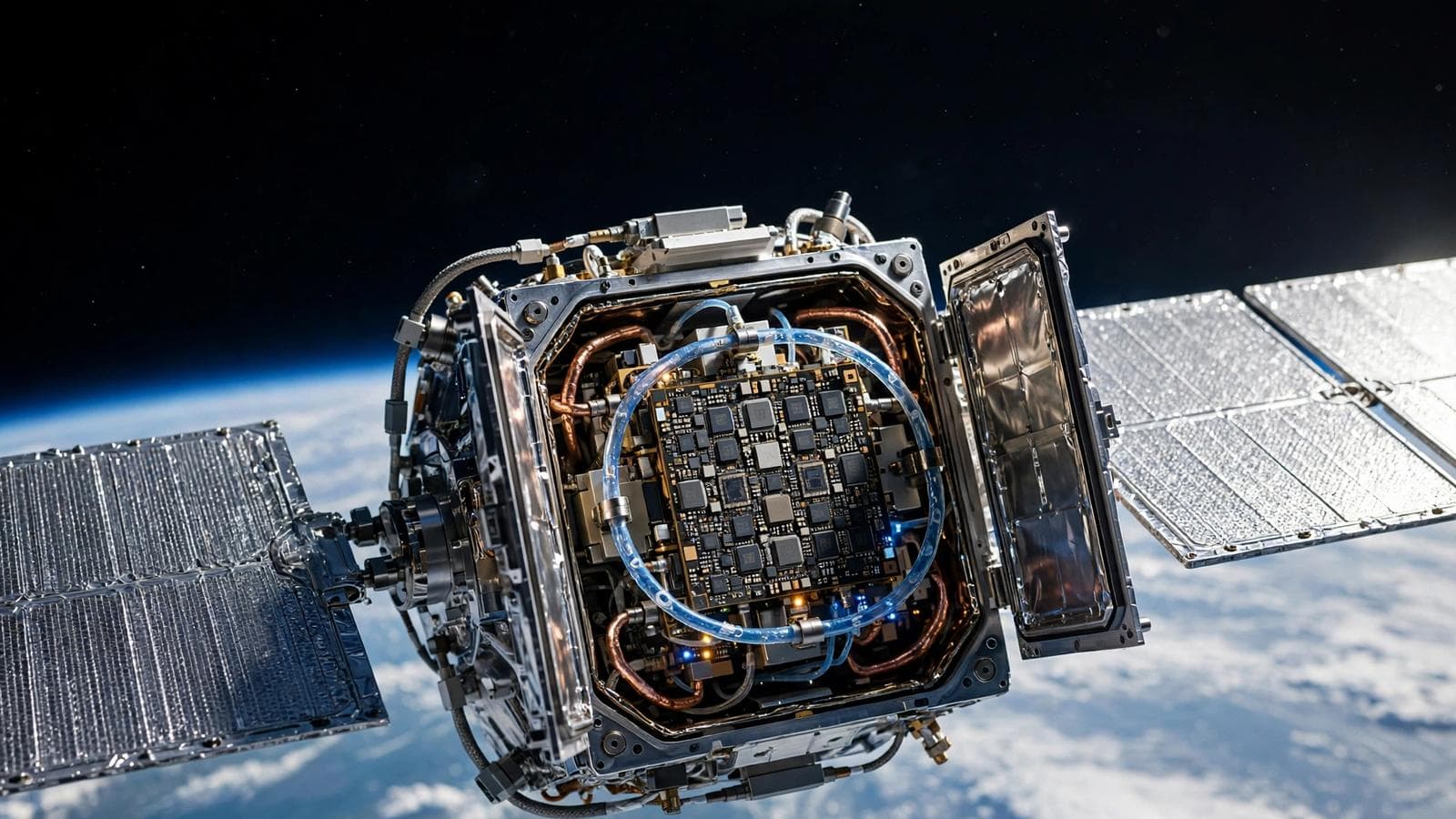
China's Libra satellite continuously trained an AI model in orbit for 45 minutes and 33 seconds. Its onboard system performed forward and backpropagation, calculated gradients, and updated the model's weights. This was actual training, not inference using an already trained neural network to produce an answer.
Libra is one of 8 computing satellites in the Star-Compute project, launched on 14 October 2026 from the Jiuquan Satellite Launch Centre. Its stated computing power is 32 PFLOPS at FP8 precision. The satellite also trained and ran Alibaba's Qwen3-32B large language model in orbit, but the published results list that test separately from the 45 minute 33 second full parameter training session. It cannot be claimed that Qwen3-32B itself trained continuously for the entire session.
Heat remains one of the main problems for systems like this. In a vacuum, the satellite cannot cool its hardware through convection and must release heat through radiation. Adaspace equipped Libra with a 10 kW liquid cooling circuit and a large deployable radiator. Both systems operated normally during the test and maintained the required thermal conditions for the computing load.
Adaspace also compared the result with a Google experiment. According to Google's published figures, its orbital accelerator prototype using TPU processors managed about 15 minutes of continuous operation in a single session. Libra lasted more than three times longer, reaching 45 minutes and 33 seconds.
After the second group of satellites reached orbit, the Star-Compute project’s total stated computing power reached almost 50 POPS. Adaspace calls it the world's largest orbital computing constellation. For now, this is a demonstration of technical feasibility: the tests show that satellite systems can process data, run trained models, and perform resource intensive training operations. The results alone do not prove that orbital data centers can compete with ground based facilities on cost, reliability, and availability.
Related
 AI agentsExperiment: I handed all my social media and my website to Grok Bot. Day 2: minus five, an ad filter and the hour the bot chose to skip
 ToolsHow to download a program from GitHub: find the installer, portable ZIP or individual file
 ToolsHow to track website changes and get price alerts with changedetection.io