AI faced a drug discovery test, and 84.5% was the top score
OpenAI introduced MedChemBench, a 99 problem test in medicinal chemistry. It measures whether models can work with molecular structures, experiments, and compound selection.
AI news faster than on the site — on Telegram KARMAZIN MEDIA
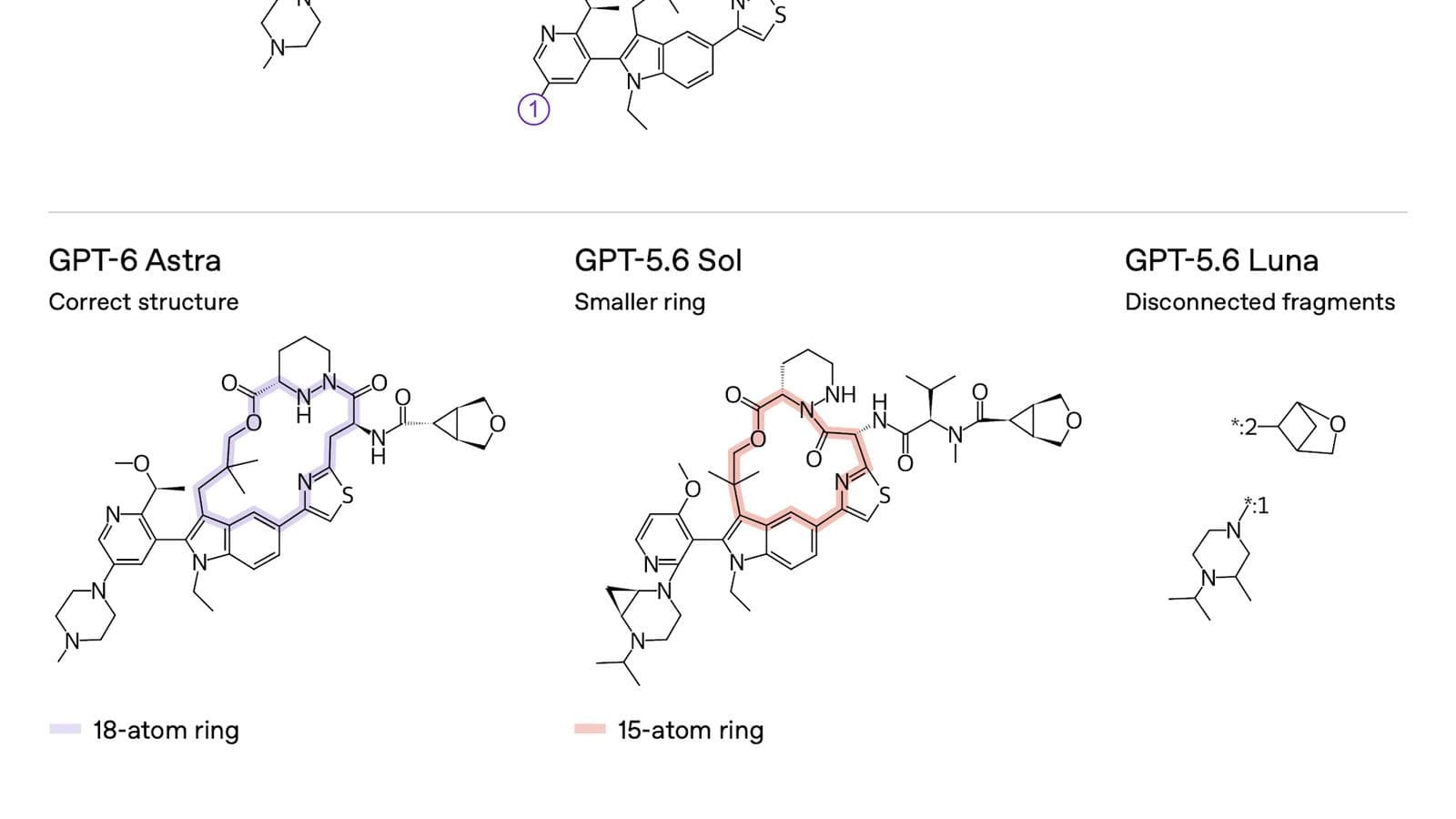
OpenAI introduced MedChemBench, a benchmark for testing AI on medicinal chemistry tasks. Models must analyze molecular structures and experimental data, explain results, compare substances, and choose compounds for further study.
The test includes 99 problems based on 117 scientific papers and patents, featuring 761 molecular structures in total. It evaluates four areas: reconstructing molecular structures, scientifically supporting conclusions, ranking and selecting compounds, and predicting their properties. One task asks models to compare three PRMT5 protein inhibitors: compound 23 suppressed the protein more strongly, while compound 24 crossed the cell barrier more effectively and broke down more slowly under liver enzymes.
In OpenAI’s testing, GPT-6.2 Astra earned 84.5% of the available credit at the xhigh reasoning level. GPT-6 Astra scored 83.3%, GPT-6.1 Sol 82%, and GPT-5.6 Sol 58.2%. GPT-6 Astra reached 95.4% on molecular structure reconstruction, but performed noticeably worse at selecting compounds and predicting numerical properties.
MedChemBench does not show that AI can already discover drugs independently: the models answered once, without tools, feedback, or new experiments.
Related
 AI agentsExperiment: I handed all my social media and my website to Grok Bot. Day 2: minus five, an ad filter and the hour the bot chose to skip
 ToolsHow to download a program from GitHub: find the installer, portable ZIP or individual file
 ToolsHow to track website changes and get price alerts with changedetection.io