AI designed 12,774 robots, but reality let only 66% through
Four AI agents designed robots and tested them in 16,427 simulations. Researchers built 135 physical machines, but only 66% cleared the obstacle course.
AI news faster than on the site — on Telegram KARMAZIN MEDIA
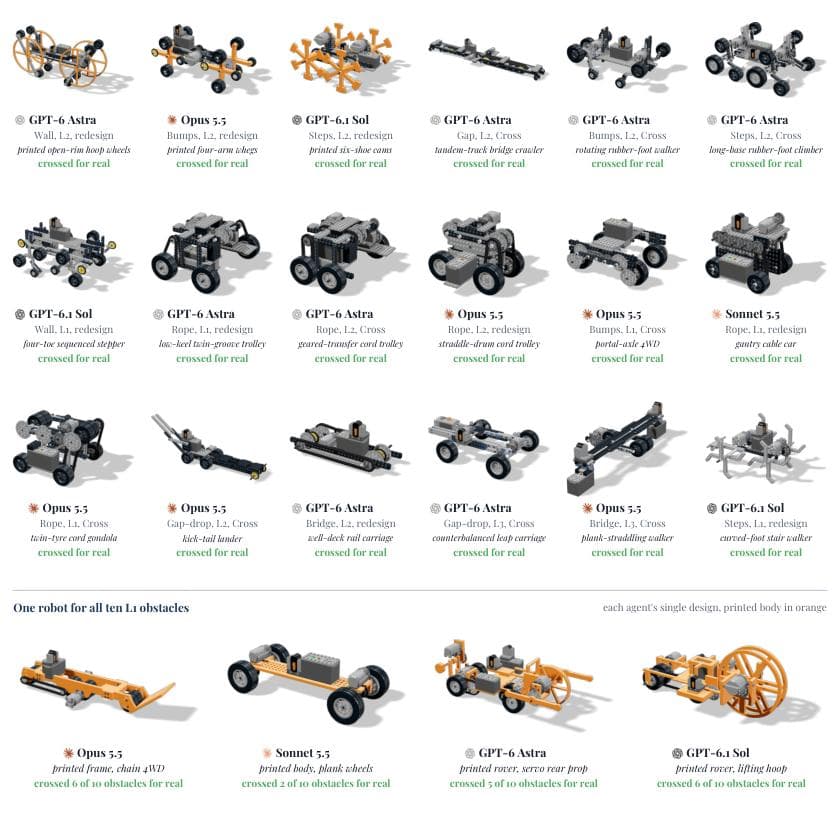
A MIT study submitted to arXiv on November 18 describes RoboBuilder, a system in which four AI agents designed both robots and their control software. They selected parts and motors, created components for 3D printing, and wrote the programs that controlled the motors.
The agents produced 12,774 designs and ran 16,427 virtual tests. Each robot had to cross a course with 10 obstacles, each available at three difficulty levels. Researchers built 135 designs that passed simulation, spending roughly 240 hours on the physical prototypes.
Reality was less cooperative. Tires slipped, joints came apart, gears disengaged, and the load shifted on sloped sections. In the end, only 66% of the designs that passed in simulation cleared all difficulty levels in physical testing.
After a failure, an agent received video of the attempt and could change the robot or the simulator settings. On the first two difficulty levels, that feedback loop raised the real-world success rate from 73% to 93%. The AI also came up with studded wheels, lever mechanisms, cable-travel systems, and walking designs that the search algorithms used in the experiment did not find.
In the physical world, 66% of the simulated successes survived.
Related
 AI agentsWhat Is an AI Agent? Plain-English Guide: How It Works, Types, Business Examples
 AI agentsExperiment: I handed all my social media and my website to Grok Bot. Day 2: minus five, an ad filter and the hour the bot chose to skip
 ToolsHow to download a program from GitHub: find the installer, portable ZIP or individual file