Nvidia's robots now learn by watching you work
Nvidia's new robot model trains on hundreds of thousands of hours of human video and moves a skill onto a machine with a completely different body.
AI news faster than on the site — on Telegram KARMAZIN MEDIA
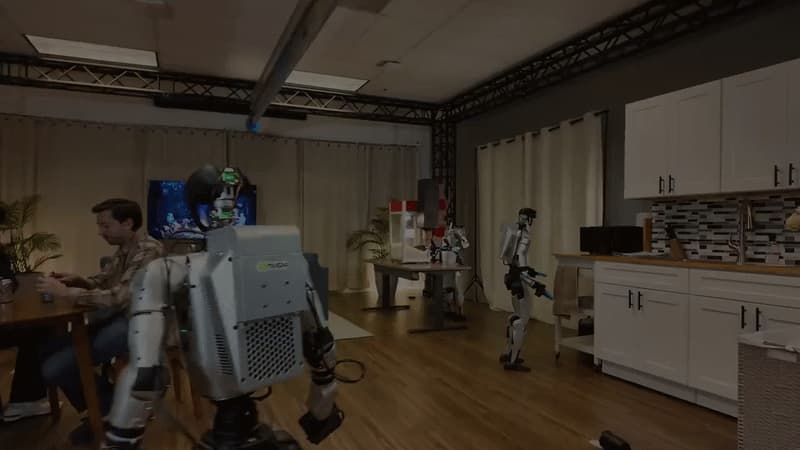
Nvidia has unveiled GR00T 2, a robot control model that doesn't just pick the next move. It predicts how the scene will look after that move. That is the trick behind the headline feature: a skill shown by a person or by another robot can be moved onto a machine with a completely different body.
The model was announced on November 9 at the CoRL robotics conference, but it is only now spreading through our channels.
Here is how it works. The model reads the latest camera frames, a text instruction and the robot's state, then produces two forecasts at once: future video and a chunk of actions. There is one shared plan, and small per-robot modules turn it into motor commands. It runs on parallel grippers, dexterous hands and humanoids like the Unitree G1.
Most of the training data is human: more than 402,000 hours of first-person video of people doing ordinary work, plus handheld gripper recordings and robot teleoperation. Nvidia has released 100,000 hours of that set on Hugging Face. The model code is promised for December.
The numbers look good. With one demonstration per task, success was 71%, and five demonstrations pushed it to 95%, although that test set was picked from tasks that learn well. Adapting a task took under 3 minutes of demonstrations and half an hour of fine-tuning on a single RTX 5090. A two-handed robot learned lab procedures purely from video recorded by cameras on a person's head and wrists, with zero teleoperation, and succeeded at all four tasks.
Paired with a reasoning model that splits the job into steps and tracks progress, the system assembled a toy plane, tractor and Hot Wheels car from scattered parts in 97 to 98 runs out of 100. There is also a lighter GR00T 2 Turbo with 2 billion parameters that runs on the robot itself: 38 ms per prediction on an RTX 5090 and 124 ms on Jetson Thor. A G1 humanoid running it already makes and serves popcorn and clears trash in an office cafeteria.
Robots used to need endless hand-holding. Now they can just watch you do it.
Related
 ToolsHugging Face: What It Is, Open AI Models and How to Use Them
 AI agentsExperiment: I handed all my social media and my website to Grok Bot. Day 2: minus five, an ad filter and the hour the bot chose to skip
 ToolsHow to download a program from GitHub: find the installer, portable ZIP or individual file