Google's AI just proved Signal chats can't be cracked
DeepMind agents wrote six million lines of math proofs for Signal's real protocol code in four weeks. That used to take years.
AI news faster than on the site — on Telegram KARMAZIN MEDIA
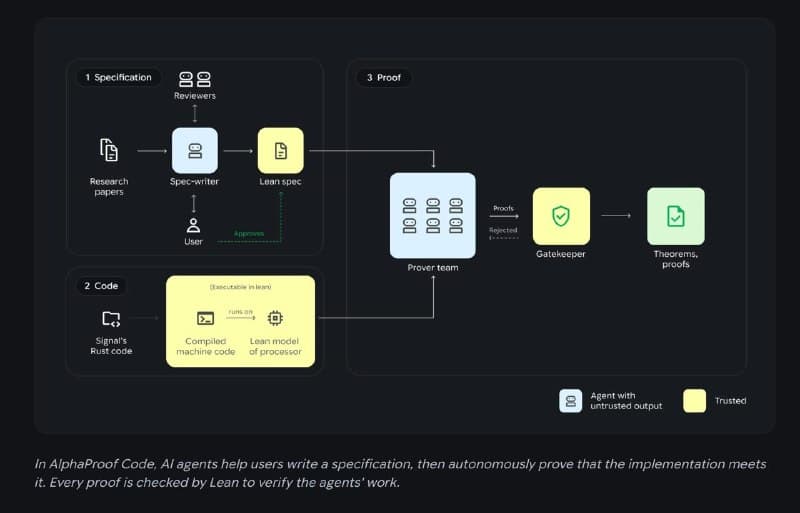
Google DeepMind says it has used AI to mathematically prove the security of the actual code behind the Signal protocol. That is the protocol encrypting chats in Signal and Google Messages, which means conversations of billions of people.
Code is usually checked with tests, reviews and audits. That catches individual bugs but never guarantees there are none left. Formal verification is stricter: you write the program's properties down as math and build a proof that the code meets them for every possible input. It is the gold standard of security, and almost nobody does it, because it is slow, expensive and needs rare specialists.
The new system is called AlphaProof Code. Humans and models translate security goals into formal specifications, and experts review every one. Then agents running on Gemini Carbon take over: they wrote more than six million lines of Lean proofs, audited their own work and flagged the spots that needed a human eye. That came to about one percent. Lean checks everything else automatically.
What sets it apart is depth. The proof does not stop at the protocol design, it reaches the compiled code that actually runs on devices. The gap between a clean design and real implementation is exactly where real vulnerabilities tend to hide. The whole job took four weeks, where expert teams usually need years.
As a sanity check, the researchers put two real, long fixed bugs back into an isolated copy of the code. Both times the system produced a machine checked proof that the buggy version was insecure. Signal CTO Ehren Kret called AI agents turning live code into valid Lean theorems a major breakthrough.
The announcement went up on November 10. DeepMind says it will open source the verification artifacts, and it wants to take the method to medical device firmware and power grid software next.
AI is no longer just finding ways to break code. Now it proves the code cannot be broken.
Related
 AI agentsWhat Is an AI Agent? Plain-English Guide: How It Works, Types, Business Examples
 AI agentsExperiment: I handed all my social media and my website to Grok Bot. Day 2: minus five, an ad filter and the hour the bot chose to skip
 ToolsHow to download a program from GitHub: find the installer, portable ZIP or individual file