GPT-6 designed an entire gadget by itself in under a week
Two OpenAI staffers handed the model the whole job of building a device for talking to Codex: the look, the board, the interface and the code. Prototypes already exist.
AI news faster than on the site — on Telegram KARMAZIN MEDIA
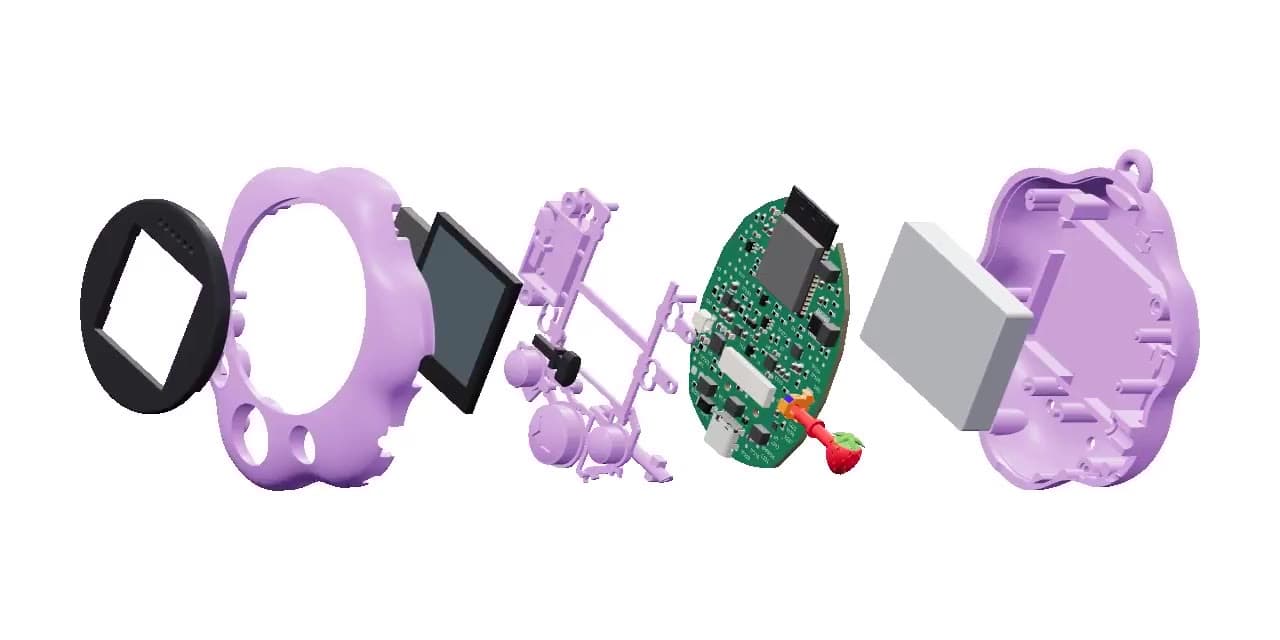
OpenAI wanted to see whether a real device could be made without any direct human edits. Two employees took GPT-6 Astra and, as a side project, asked it to come up with a gadget for talking to Codex. In under a week the design was done.
The model did almost all of it. It wrote the functional requirements first. Then it came up with the look, drawing on OpenAI's recent Work Louder collaboration and references from games and toys, so the result is a lilac keychain with a screen that looks more like a Tamagotchi than serious hardware. After that Astra designed the enclosure and the internal mounts, picked the electronic components, laid out a circuit board that fits inside, built the interface and wrote the firmware and the Codex integration.
A contract manufacturer built a small batch of prototypes in under a month. But the model didn't get it production ready on its own, and OpenAI says so: it took several rounds of review and fixes, because Astra didn't consistently account for the manufacturer's limits, tolerances and assembly details. The company says those gaps show exactly what future models need to learn.
The gadget is just the showcase. OpenAI's hardware and infrastructure engineers already use Codex and ChatGPT to edit CAD models, prepare manufacturing drawings and set up simulations. Their token usage has grown 23 times since February. On the internal BenchCAD 2.0 test, where a model rebuilds 3D parts and assemblies and traces connections on circuit boards, GPT-6 Astra at its highest setting scored 0.594, while a newer unnamed internal model already hits 0.875.
It's moving outside too. With the Chip Ganassi Racing team the models turn 3D scans of old parts into editable CAD models and drawings when the original files are gone. And with Mazda, OpenAI started a research project where Astra tries out nose shapes, runs airflow and crash simulations and looks for designs where styling and aerodynamics stop fighting each other.
Engineers don't need to pack up yet. But two people and one model drafting a gadget in a week already sounds like the new normal.
Related
 ToolsWhat Is a Token in AI, in Plain Words: Cost, Context Window, How to Estimate
 AI agentsExperiment: I handed all my social media and my website to Grok Bot. Day 2: minus five, an ad filter and the hour the bot chose to skip
 ToolsHow to download a program from GitHub: find the installer, portable ZIP or individual file