Xiaomi robots just worked a full factory shift, no paycheck needed
CyberOne 02 humanoids sorted car parts for eight hours at Xiaomi's plant, fixed their own mistakes and took two charging breaks.
AI news faster than on the site — on Telegram KARMAZIN MEDIA
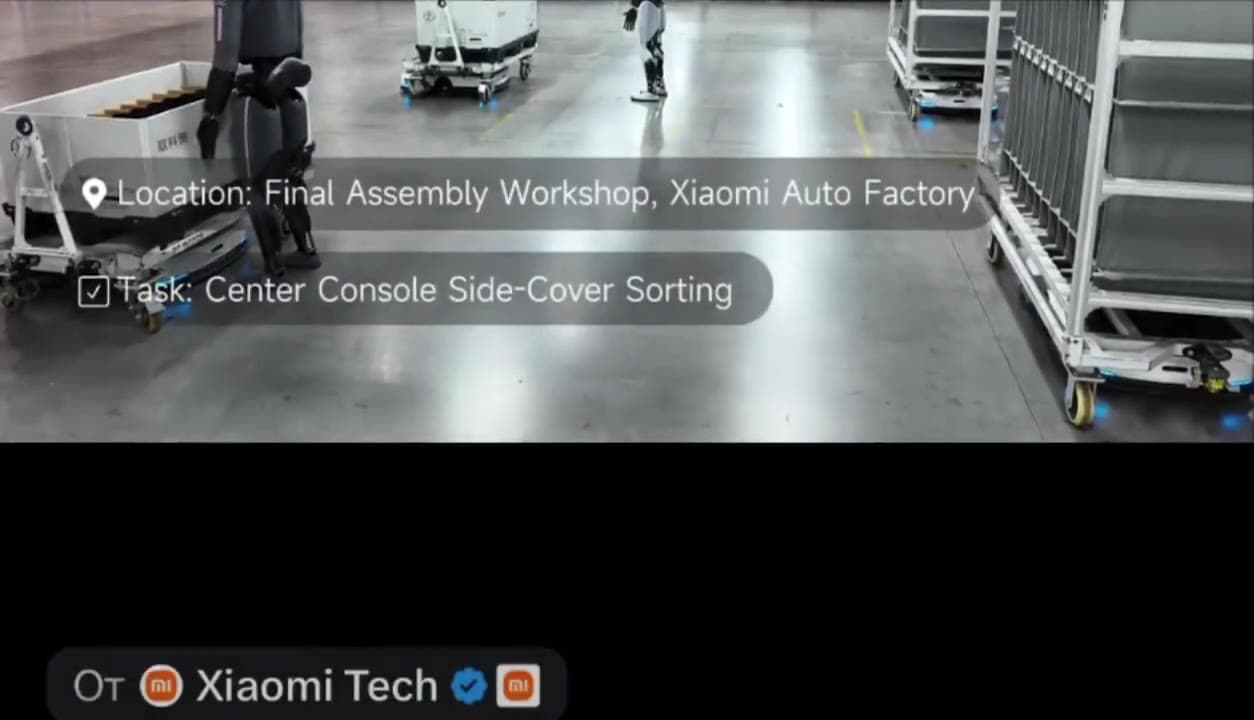
Two Xiaomi humanoid robots, one black and one white, just worked a full shift at the company's car plant. Xiaomi founder Lei Jun posted the footage: CyberOne 02 ran for 8 hours and 5 minutes in the final assembly shop without people stepping in. Xiaomi says that covers the full daily quota for the workstation.
The job is not an easy one. The robots sort center console side panels, which are large, flexible, oddly shaped parts tossed into a bin at random angles. The robot pulls a panel out, turns it the right way and drops it into the correct rack slot, in the same order the cars come down the line. The line sets the pace, not the robot.
Automated carts bring parts in, and the humanoids adapt to them, changing their route and stride and waiting while a cart swaps out. If a part lands crooked or fails to seat, the robot notices and fixes it on its own. They stepped away to recharge twice, after 3 hours 2 minutes and after 6 hours 3 minutes. In the second half one of them dropped a part on the floor, and a separate wheeled robot came over to pick it up.
CyberOne 02 runs on Xiaomi-Robotics-1, a model the company released this summer that takes in what the robot sees and outputs movements directly. The robot has been training at the plant since early this year; in March it spent three hours straight fitting nuts in the casting shop. Xiaomi is also testing it in a company dorm, where it already handles chains of 50+ actions across three rooms for over half an hour.
Asked why a factory needs a humanoid at all, Lei Jun said the hardware doesn't have to change, so the same robot fits many different jobs. Xiaomi calls this an internship and an early check, not a production rollout, and it hasn't shared speed or error numbers.
The verdict: eight hours on a real line still counts as a demo, but it no longer looks like a circus act.
Related
 AI agentsExperiment: I handed all my social media and my website to Grok Bot. Day 2: minus five, an ad filter and the hour the bot chose to skip
 ToolsHow to download a program from GitHub: find the installer, portable ZIP or individual file
 ToolsHow to track website changes and get price alerts with changedetection.io