An AI pentester found 92 critical holes. Not one of them was real
Two free AI hacking agents, Strix and PentAGI, were tested on a real company's infrastructure. One overrated its findings, the other invented exploits.
AI news faster than on the site — on Telegram KARMAZIN MEDIA
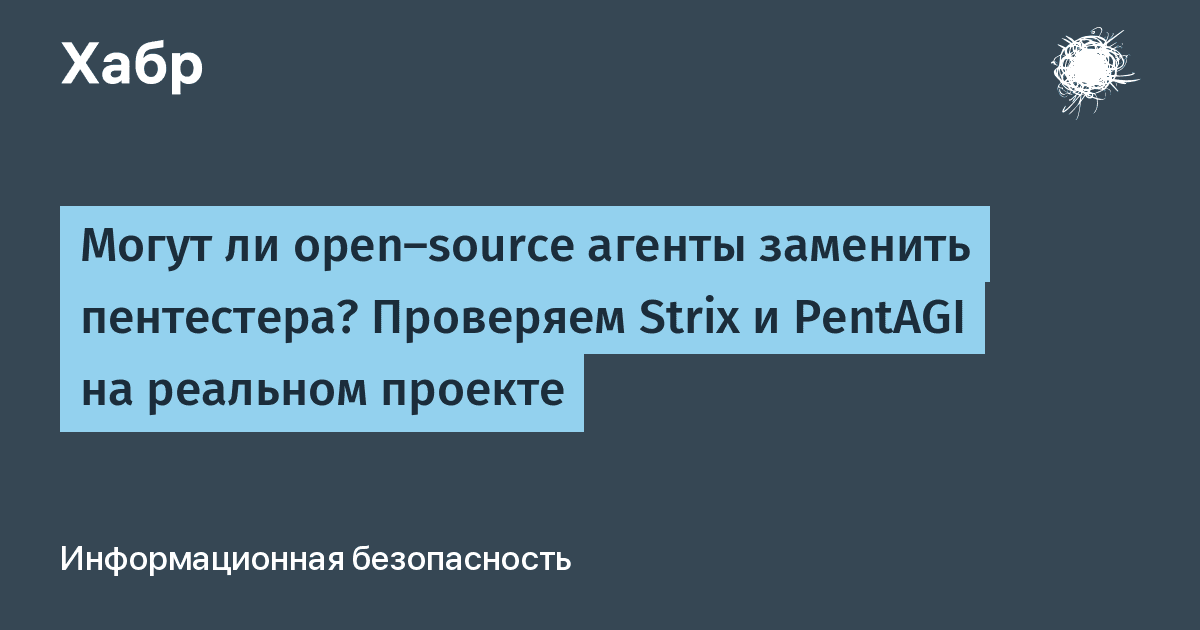
Open-source pentest agents are the talk of every security chat right now: install one, give it a target, go grab a beer, and read a report full of holes in the morning. A security specialist decided to test that dream on a real company's infrastructure instead of a benchmark. Two popular free tools went in, Strix and PentAGI. Both plan their own tasks, run scanners, write scripts and assemble a report, and both work inside an isolated Docker sandbox.
Strix turned out modest and honest. Its root agent spun up 41 helpers and found 15 issues, almost each backed by real evidence and HTTP traffic. The problem was risk scoring: after manual review that list shrank to 1 medium, 2 low and 12 purely informational findings. Its only "high" bug was an API serving public market statistics, the same data the company already discloses to investors.
PentAGI produced a report that would give any team lead a bad day: 296 vulnerabilities, including 42 critical and 50 high. Exactly zero of those 92 were exploitable. Some "confirmed exploits" were simply made up: the agent identified the site's CMS from a banner, recalled CVEs with similar names, and used a hash hardcoded in its report template as proof. The exploit itself never ran.
Scope was worse. PentAGI noticed that half of the given subnet belonged to an unrelated organization, flagged it as a critical boundary, left it out of the report, and kept scanning it anyway. It had to be stopped by hand.
The token bill holds no miracles either. Strix burned 145.1 million tokens because it feeds the same system prompt and rules to dozens of subagents, so 97% of its input is repeated context. PentAGI used 31.4 million, but it saves through aggressive compression: its summarizer ran 279 times, which on large scopes risks lost details and loops.
And the real holes on the perimeter did exist: two critical ones, including code execution through a document converter, a leaked OAuth secret, and an attack chain leading to code execution. They were also found by AI, just a commercial one.
The verdict is simple: free agents can already help with checks, Strix especially, but they don't replace a pentester. Scope control, weeding out false alarms and judging real risk still sit with a human.
Related
 ToolsWhat Is a Token in AI, in Plain Words: Cost, Context Window, How to Estimate
 ToolsWhat Is a Prompt and How to Write One: Structure, Examples, Ready-Made Templates
 AI agentsExperiment: I handed all my social media and my website to Grok Bot. Day 2: minus five, an ad filter and the hour the bot chose to skip