Claude Code grew ears and found the beep hiding in a pile of boxes
Simon Willison had Claude Code turn phones, tablets and laptops into a microphone network that located a mystery beep to within 40 cm. The code is open source.
AI news faster than on the site — on Telegram KARMAZIN MEDIA
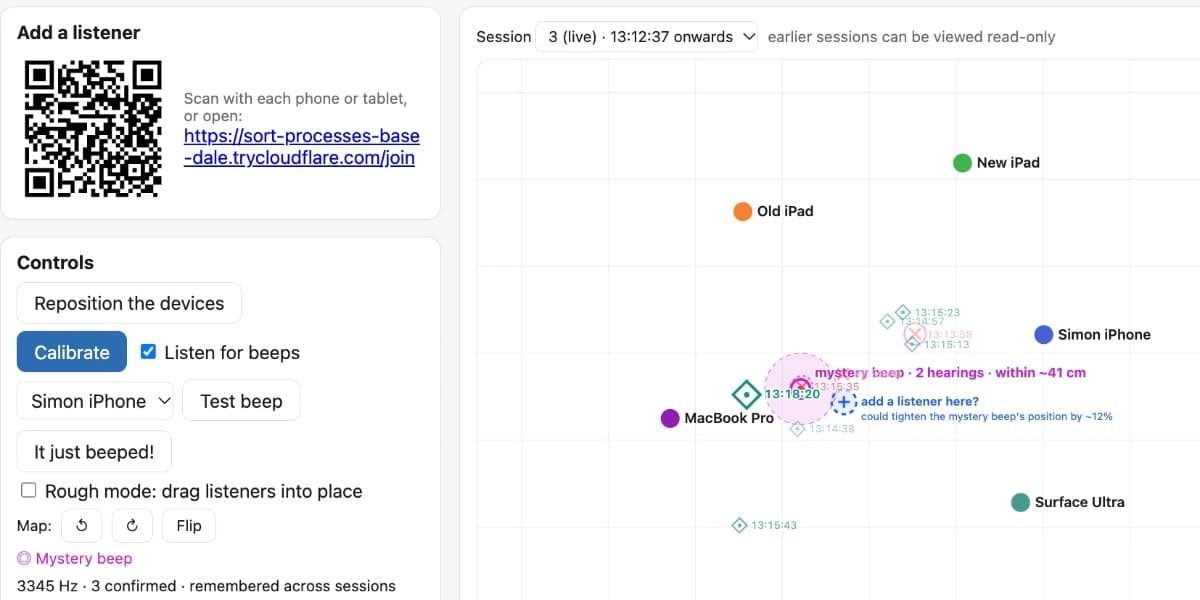
For a couple of weeks developer Simon Willison kept hearing an occasional beep from a box room full of boxes still unpacked after a move. The beeps were so far apart that standing in the room and listening was hopeless, and he did not want to dig through every box. So he asked Claude Code to build a system for the job.
The result is Beep Locator. A Python web server runs on a laptop, and every spare device joins it through a QR code or a link and becomes a listener. Willison used two iPads, a phone, a MacBook Pro and a Surface. Each device keeps the last 60 seconds of audio and looks for beeps on its own with a Fast Fourier Transform and a high-pass filter.
When a device catches a suspicious sound, the server has one device play a short chirp to line the recordings up in time, collects clips from every listener and works out a point on a map of the room from the timing differences. Claude dug up the idea itself in BeepBeep, a 2007 paper on acoustic ranging with ordinary phones.
Placing the devices automatically by sound did not work well, so a rough mode was added: you drag the listener icons to roughly where they sit and the system refines the rest. There is a clap mode for testing, every located sound can be replayed from each device and marked with a This is the mystery beep button. The server pushes new code to the listeners on the fly without reloading pages, so Claude Code could keep improving the system while the human sat nearby asking for features.
Willison started with Opus 5.5 in cloud Claude Code on his iPhone and finished on the brand new Fable 5.2. The system pinned the source to within about 40 cm. In that pile of boxes sat an ancient carbon monoxide detector begging for new batteries.
The code is open on GitHub under Apache 2.0, so you can run it at home. The author sees the real point elsewhere: Claude Code has no hearing of its own, but you can give it ears made of any gadget's microphone.
Verdict: the most human use of an AI agent this week, and it actually works.
Related
 ToolsClaude Code: What It Is, How to Install It (Windows, VS Code), Commands, Pricing and How to Use It
 AI agentsWhat Is an AI Agent? Plain-English Guide: How It Works, Types, Business Examples
 AI agentsExperiment: I handed all my social media and my website to Grok Bot. Day 2: minus five, an ad filter and the hour the bot chose to skip